
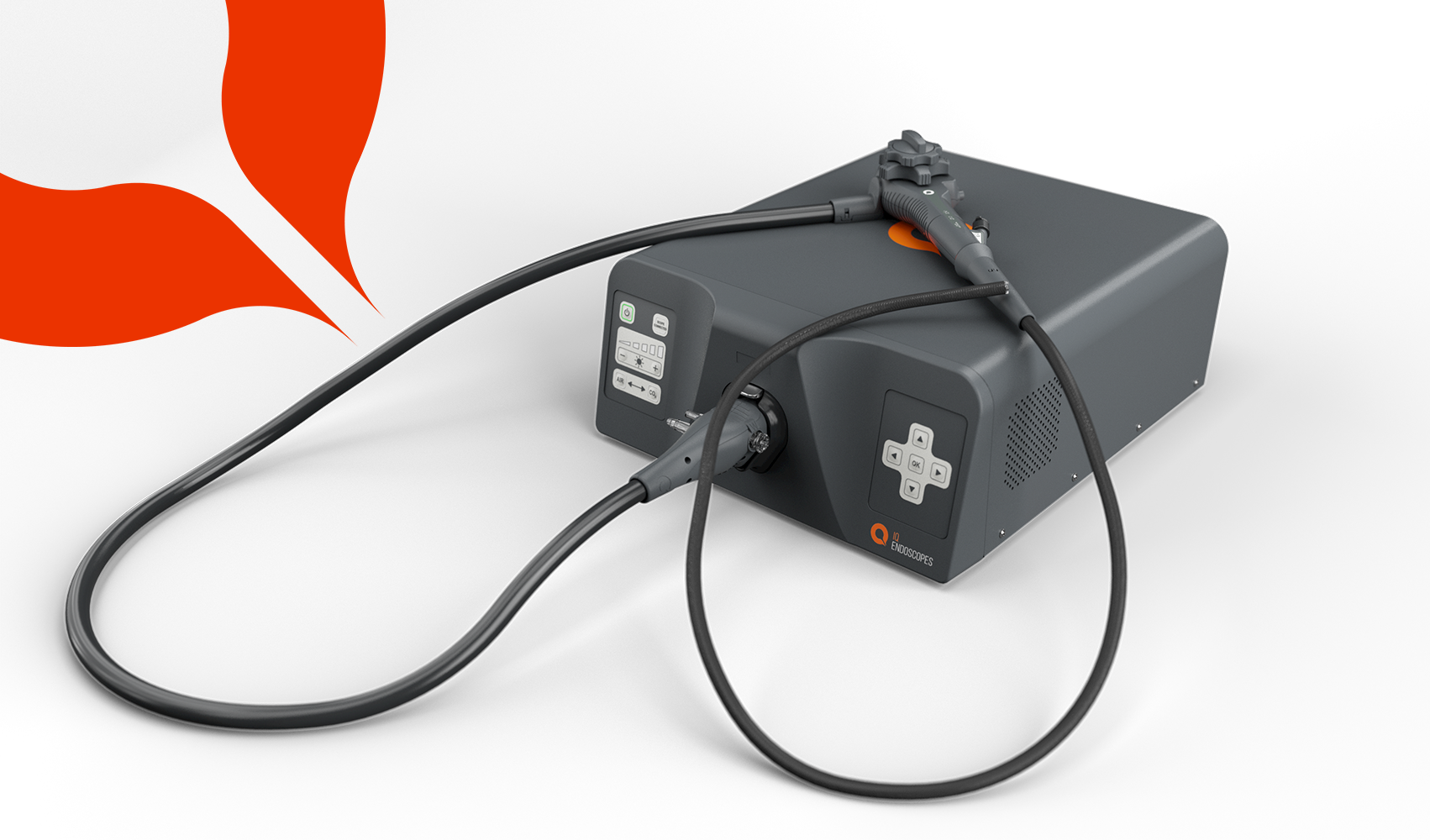
The future of gastrointestinal (GI) diagnostics will be shaped by a single defining principle: flexibility. As NHS endoscopy services continue to operate under immense pressure, delivering more activity than ever while battling workforce shortages and capital constraints, the ability to adapt, scale and reconfigure capacity within existing infrastructure is crucial.
At IQ Endoscopes, we believe this requires a blended model, where single-use and reusable endoscopes work together to create sustainable, high-performing services. Our intention is not to replace existing technology, but to augment capacity, strengthen infection control and improve operational resilience without relying on major estate expansion.
The capacity challenge isn’t going away…
Even before the Covid pandemic, endoscopy demand outpaced supply. The most recent Joint Advisory Group (JAG) census shows a system still under strain. In early 2023, NHS services were running at 110% of pre-pandemic activity, yet barely half met urgent suspected cancer targets and only about a quarter met routine and surveillance waits, despite widespread reliance on insourcing and independent sector support.¹
National diagnostics data underscore the point. The monthly DM01 collection confirms sustained pressure on endoscopy and other key tests, with the 6-week operational standard breached across multiple months.²
The underlying issue is clear, even when pushing existing teams and reprocessing pathways to their limits, the system still cannot meet demand.
Expanding throughput inside existing infrastructure: A capital challenge
The traditional route to increased endoscopy capacity – new rooms, expanded decontamination suites, additional drying cabinets – comes with significant capital expenditure. But many NHS trusts face:
- Restricted capital budgets
- Competing priorities (across theatres, imaging and digital transformation)
- Ageing decontamination equipment
- Limited space for further estate modifications
And as reprocessing standards tighten, the capital burden associated with reusable endoscope pathways only increases. As a result, expanding capacity by scaling reusable workflows often becomes a financial and logistical bottleneck.
The hidden capacity loss
While endoscopy room time is visible and planned, the reprocessing cycle is the hidden variable that governs real throughput. Studies show:
- Approximately 76 minutes of staff time may be required to reprocess one flexible endoscope under high-level disinfection pathways³
- Updated standards add 24.3 minutes and $52-$67 in additional per procedure reprocessing costs, not including capital, further stretching workflows4
In departments already operating at maximum output, any disruption – staff sickness, decontamination machine downtime, delayed drying cycles – can result in list overruns, cancellations or reduced case allocation, none of which can be solved by capital expansion alone.
Flexible technology inside existing infrastructure
This is where single-use endoscopy can provide practical, immediate relief. Because single-use devices bypass the entire reprocessing chain, they:
- Remove dependency on reprocessing machines and drying cabinets
- Eliminate turnaround time, enabling continuous room flow
- Reduce cancellations due to reprocessing delays or equipment damage
- Avoid capital expenditure associated with expanding decontamination capacity
- Provide predictable, consistent device performance with no variability from wear-and-tear
Crucially, this enables endoscopy leads to increase capacity inside their existing infrastructure without needing additional procedure rooms, additional decontamination investment or additional staff dedicated to reprocessing. This is flexibility where it matters most. I the everyday operational reality of endoscopy services.
Flexible models that complement reusables, not replace them
IQ Endoscopes supports a model in which trusts retain reusable endoscopes for high-acuity therapeutic cases and specific clinical scenarios while deploying single-use devices to smooth flow, address bottlenecks and expand diagnostic throughput.
This blended model aligns with JAG’s recommendations on optimising list utilisation and ensuring the right cases flow through the right pathways.5
Infection control and quality benefits within the same footprint
Global literature continues to document outbreaks linked to residual contamination from reprocessed endoscopes, even in well-run units. NHS IPC guidance recognises the ongoing need for strengthened governance around high-risk devices.6 7
Single-use endoscopes offer a risk-free alternative for selected cases without requiring additional capital investment in high-grade sterilisation or drying infrastructure.
This is not just a safety benefit, it is an opportunity to allocate reusable endoscopes more efficiently to complex procedures where their advanced therapeutic capabilities are essential.
A call for a pragmatic, flexible future
The NHS endoscopy landscape is not suffering from a lack of clinical expertise or dedication, it is constrained by capital limits, workforce shortages and infrastructure bottlenecks.
The future of GI diagnostics requires:
- Flexible capacity within existing estates
- Reduced capital dependence for expanding throughput
- Operational models that blend reusable and single-use devices
- Reduced reprocessing friction to maximise every clinical session
We are committed to partnering with NHS services to deliver this next phase of evolution. By working alongside reusable endoscopes, we aim to help trusts unlock capacity where it already exists.
- National Census of UK endoscopy services in 2023 (2024), https://fg.bmj.com/content/16/1/20
- NHS Diagnostic Waiting Times and Activity Data (2025), https://www.england.nhs.uk/statistics/wp-content/uploads/sites/2/2025/03/DWTA-January-2025-report_SDM38.pdf
- A glimpse at the trust cost of reprocessing endoscopes: Results of a pilot project (2017), https://www.bostonscientific.com/content/dam/bostonscientific/uro-wh/portfolio-group/LithoVue/pdfs/Sterilization-Resource-Handout.pdf
- Costs involved in compliance with new endoscope reprocessing guidelines (2024), https://e-ce.org/journal/view.php?number=7845
- Running a productive endoscopy service: Practical strategies for services (2025), https://www.thejag.org.uk/CMS/UploadedDocuments/Scheme/Scheme5/2025-07-15%20-%20Running%20a%20productive%20endoscopy%20service.pdf
- Endoscope processing effectiveness: A reality check and call to action for infection preventionists and clinicians (2025), https://www.ajicjournal.org/article/S0196-6553%2825%2900290-1/fulltext
- Healthcare associated infection (HCAI) compendium of guidance and resources (2026), https://www.england.nhs.uk/long-read/healthcare-associated-infection-hcai-compendium-of-guidance-and-resources/