
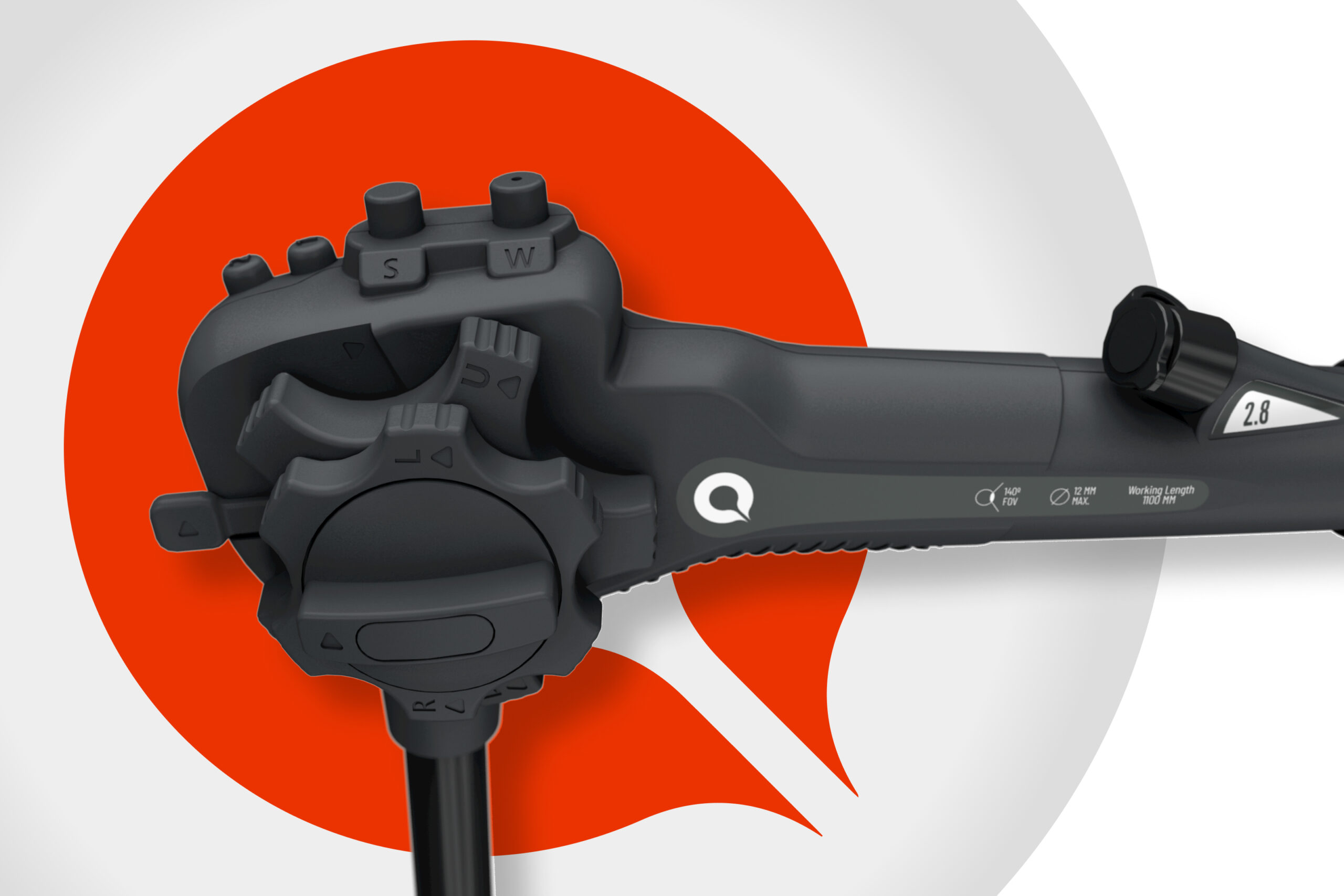
How the intelligent design of IQ Endoscopes has helped to reduce waste and drive more sustainable healthcare practices.
At IQ Endoscopes, sustainability is a design principle that has been with us from the start. We define sustainability as the balance of People, Planet and Prosperity: ensuring the delivery of safe, effective care today without compromising on the health or resources of tomorrow. This means considering environmental impact, patient access and impact, and economic viability in equal measure.
Single-use and sustainability can seem like conflicting ideas, but that’s only if they are viewed in isolation. The full lifecycle, from material sourcing and manufacturing to use, recovery, and system-level efficiency, can paint a different picture.
“Sustainability starts at design,” says Matt Ginn, CEO of IQ Endoscopes. “It’s not an afterthought. Every material, every process, every clinical pathway we come into contact with is carefully assessed on whether or not it can help us drive sustainable single-use endoscopy and ultimately help us support clinicians in helping more patients.”
From concept through to production, IQ Endoscopes’ engineering and sustainability teams collaborate to help minimise material use through modular, high-volume manufacturing that borrows many principles from the automotive industry. Where possible the team endeavour to help create a circular-economy by ensuring materials that are suitable can be recovered and repurposed responsibly.
Matt explains: “We have worked very hard to overcome any sustainability or environmental concerns from both clinical and procurement around the use of our technology. We continue to measure both the clinical and environmental impact at every stage. As a fairly young company, we are able to be agile and adapt our approach in accordance to clinical requirements.”
Our design process measures sustainability across seven key factors: time, carbon, water, energy, human resources, chemicals, and materials. Each factor informs how we innovate from component to clinical workflow.
The hidden footprint of “reuse”
Reusable endoscopes have long been seen as the greener choice but when you factor in the resource-intensive process of cleaning, maintaining, and repairing them, the environmental impact tells another story.
Each reusable scope must survive hundreds of decontamination cycles. Every cycle consumes large volumes of water, energy, and chemicals, generates contaminated waste, and requires extensive human resources to operate and maintain the process.
Independent evaluations have shown that decontamination represents one of the highest single sources of carbon and chemical use in an endoscopy unit. Across the NHS, that translates into thousands of litres of water and kilowatt-hours of electricity consumed every day simply to keep reusable devices safe. Even with rigorous cleaning, contamination can also persist, leading to unplanned downtime, equipment failure, and higher replacement rates, all of which can compound the environmental and financial burden. In worst case scenarios, this can result in equipment not being available, case cancellations, and ultimately, patients not getting the diagnosis they need, when they need it.
Single-use technology removes this hidden footprint. There’s no need for reprocessing, no chemicals, and no contaminated wastewater. Each IQ Endoscope is delivered sterile and ready to use, ensuring reliability without the overheads and emissions of cleaning infrastructure.
Matt says: “We want to emphasise that our aim is not for single use endoscopy to replace reusable technologies, instead we believe that the single use endoscopes will be able to complement current reusable technologies in their deployment within a health setting. Single use endoscopy can enable additional patients to be diagnosed in settings away from the endoscopy suite, removing potential pressures on reusable inventory, required decontamination and endoscopy waiting lists.”
Intelligent design for a more sustainable future
Single-use doesn’t have to mean single-life, which means IQE’s design philosophy has been built around trying to ensure each element of our device can help to support more sustainable practices. From the modular design that has been purposefully engineered to streamline manufacturing and minimising material use, to our efforts to develop closed-loop partnerships that help us turn waste into future resources, at every juncture we are looking at ways to limit our impact.
Together, these principles create what we call ergonomic sustainability, devices that feel familiar in the hand of the clinician and can therefore be more seamlessly used and scaled, inside and outside of the endoscopy suite.
System-level sustainability
The environmental benefits of single-use reach far beyond the factory floor. They extend into how healthcare itself operates.
By removing the need for centralised decontamination, hospitals can free up staff time and resources for direct patient care, reduce chemical and water use by thousands of litres per year and cut emissions associated with reprocessing equipment.
Crucially, when you look at patient pathways, the sustainability gains multiply. Single-use devices enable community-based diagnostics and one-stop appointments, bringing procedures closer to home and further away from the endoscopy suite or healthcare systems under immense pressure. Greater access means pain-points upstream in surgical waiting lists, as an example, are alleviated. Fewer hospital visits, shorter waiting lists, and lower travel emissions that helps to improve healthcare and environmental sustainability.
An independent lifecycle assessment of IQ Endoscopes’ single-use design found potential carbon savings of between 302 and 1105 tonnes CO₂ per year, depending on deployment scenario, representing reductions of 11 to 57% versus reusable models.
Those numbers capture more than just product impact, they reflect the bigger picture of efficiency of faster, more accessible care for patients.
Closing the loop
Sustainability doesn’t end when a procedure does. We are working closely with a waste management service partner within the NHS, who are helping us to map out a recycling pathway that supports our long term sustainability goals. This currently includes our endoscopes being processed through a high-temperature energy recovery process that helps to generate power to run their facilities.
This approach shifts the mindset from disposal to resource recovery.
Value over volume
True sustainability isn’t about making products last forever; it’s about making systems work better and more efficiently. Reusable equipment demands high capital investment, infrastructure, manpower, and ongoing energy input. When those full-system costs are measured, both financially and environmentally, single-use can deliver a lower total footprint.
The value also lies in reliability and accessibility: a scope that’s always available, that is easy to use, adopt and scale across teams, that reduces cancellations and accelerates diagnosis, directly contributes to better outcomes and less wasted time and travel.
Matt says: “The perception is that you’re putting a premium product in the bin, but the reality is that you’re reducing total system waste. Less time, less energy, and less emissions included. This is what value-based sustainability in healthcare really means.”
Towards a smarter, lower-impact future
Sustainability in healthcare isn’t defined by how long something lasts, it’s defined by the balance it achieves.
At IQ Endoscopes, we’re designing technology that delivers exceptional clinical performance while reducing strain on healthcare systems that need support.
From intelligent materials to modular manufacturing, from patient-centric pathways to measurable carbon savings, we’re proving that single-use and sustainability can coexist and even reinforce one another.
A sustainable healthcare future isn’t about returning to old models of reuse. It’s about designing smarter systems that protect patients, professionals, and the planet alike.