
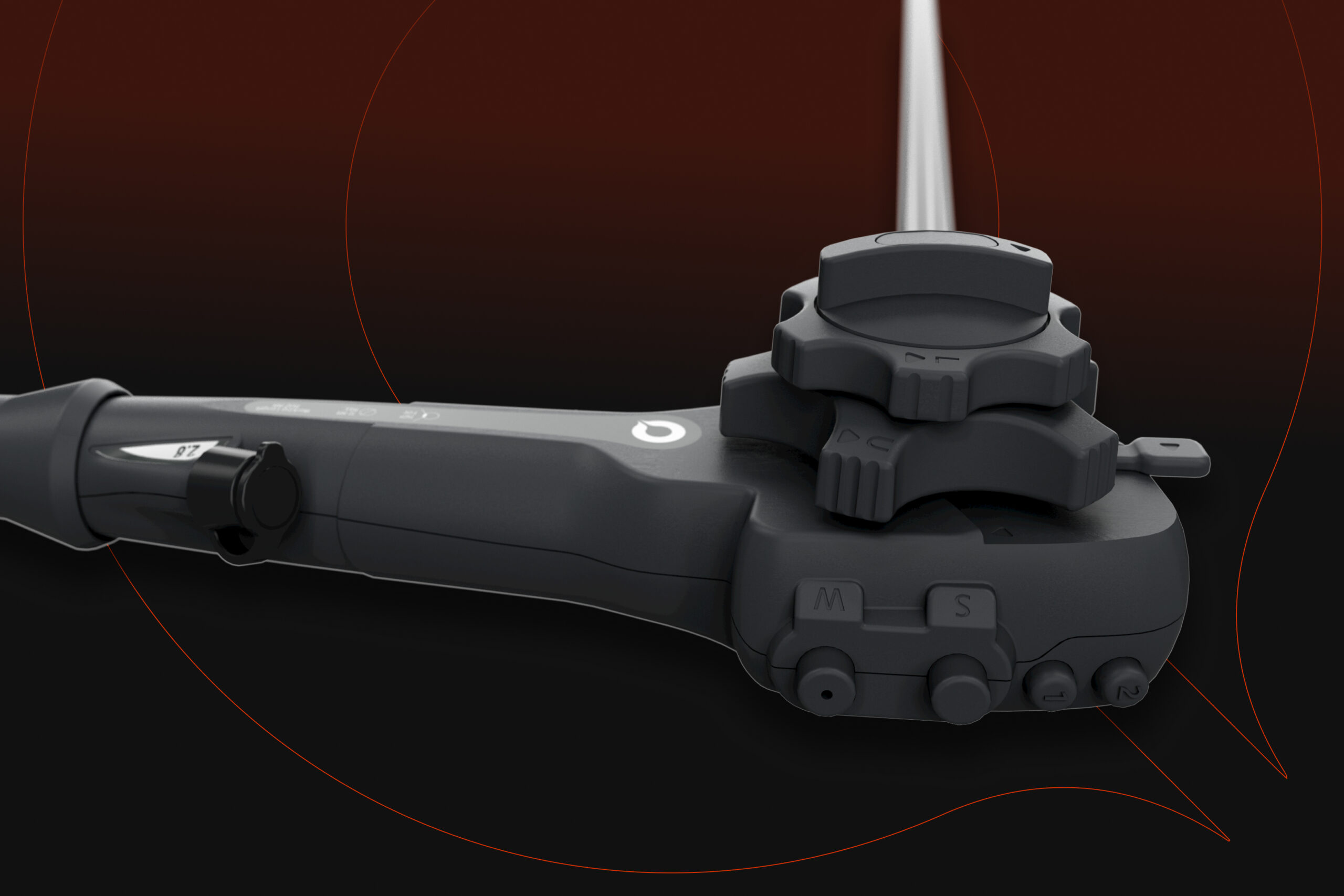
At IQ Endoscopes, design isn’t just about making something single-use. It’s about designing for the bigger endoscopy picture; for clinicians, for healthcare systems, for patients and the planet.
The IQ in IQ Endoscopes stands for Innovation and Quality. From the very beginning, that balance has defined our approach to design. Creating a single-use endoscope that’s viable for clinicians and healthcare providers alike meant more than simply matching the performance of reusable devices. It meant complimenting the reusable endoscopy industry and, at times, improving on it.
As founder Dr Patrick Ward-Booth, who spent more than 40 years in endoscopy, explains: “We wanted to provide clinicians with endoscopes that were as good as, and in some cases better than, what they were using. But we also wanted to ensure that providers, especially the NHS, could afford them. It’s no use designing a single-use endoscope if the healthcare system can’t afford or sustain it.”
The fundamental tension between performance and practicality has guided every design decision at IQ Endoscopes ever since.
Designing for the bigger picture
When people think of innovation in endoscopy, they often focus on the device itself. But the real challenge isn’t just designing a single-use scope. It’s designing for a whole ecosystem: clinical workflows and adoption, patient safety, infection control, training, cost efficiency, and sustainability.
Reusable endoscopes have long carried significant operational burdens. Each device must withstand years of harsh decontamination cycles, a process that consumes vast amounts of water, electricity, and chemicals, while requiring skilled staff time. A multiple cleaning cycle period of three to five years that is costly in more ways than one. Even with rigorous cleaning, research has shown that biofilm and contaminants can persist in reusable scopes, creating a small but ongoing risk of cross-infection.
Dr Ward-Booth saw this first-hand: “The rate-limiting step in improving endoscopy was decontamination. The solution was to avoid it entirely and that means going single-use.”
By removing the reprocessing bottleneck, single-use scopes can dramatically increase productivity. There’s always another sterile device ready to go, eliminating downtime from damaged or unavailable scopes. But the benefits extend far beyond logistics, they reshape how and where diagnosis and care can be delivered.
Ergonomic integrity: a device with that “familiar feel”
The performance means nothing if the device doesn’t feel right in a clinician’s hands. Years of muscle memory mean that even small changes can increase fatigue of the endoscopist. That’s why ergonomic integrity has been at the heart of our design philosophy. The anatomy of our scopes have been built with the user in mind. We set out to ensure that our single-use scopes feel and function like reusable ones and that means fundamentally preserving the familiarity clinicians rely on, while subtly improving comfort and precision. From a design perspective, this meant focusing on:
- Grip and balance: The handpiece is carefully weighted to sit naturally in the hand, reducing strain over long lists of procedures.
- Tactile control: Our engineers recreated the same responsive control wheels clinicians are used to, ensuring tip movement feels intuitive, immediate and familiar.
- Layout and reach: Every button, port, and lever is positioned exactly where clinicians expect them to be, maintaining effortless usability. And crucially, adoption.
This ergonomic continuity reduces the learning curve and cognitive load, letting clinicians focus entirely on the patient, not the device. The IQ Endoscope is deliberately designed to replicate the ergonomic performance of a reusable endoscope.
“Once clinicians have handled the scope and seen its performance, any initial resistance to change completely disappears,” says Dr Ward-Booth. “They quickly realise it’s not just a single-use alternative, it’s an evolution.”
Designing for value, not just cost
Healthcare systems everywhere face increasing demand and limited budgets. Every single healthcare system is being asked to do more with less. That means designing a world-class single-use device only matters if it’s financially viable for healthcare providers.
At IQ Endoscopes, that means designing for value-based healthcare, considering the full cost-to-care equation, from procurement through to patient outcomes.
Eliminating reprocessing not only reduces equipment downtime, but also saves on utilities, maintenance, and manual labour. When you consider these operational efficiencies, alongside reductions in cross-infection risk and earlier diagnosis enabled by more accessible endoscopy, the value becomes clear.
As Dr Ward-Booth puts it: “Single-use helps resolve the productivity gap in endoscopy. By ensuring availability, reducing turnaround time, and improving access, we can meet rising demand more effectively and at lower total system cost.”
Designing for today, and tomorrow.
Ultimately, our focus goes beyond ergonomics and manufacturing, it’s about enabling a smarter, more sustainable and accessible healthcare model. Single-use endoscopy opens new opportunities for community-based diagnostics, same-day assessment, and early detection of disease.
IQ Endoscopes CEO, Matt Ginn, explains: “Our endoscopes have been created to help more endoscopists and service providers enhance their ways of working. They are plug-and-play and ready-to-use and our modular design philosophy contributes to our single-use endoscope having many similarities to reusable ones, meaning healthcare teams can be easily and rapidly trained on our devices and our endoscopes can be deployed when and where they are needed.”
Matt continues: “Earlier diagnosis improves outcomes for patients, reduces the need for intensive interventions, and ultimately lowers the environmental and financial cost of care. That’s the bigger picture behind our design. We’re not just innovating for innovation’s sake, we’re building technology that makes endoscopy more efficient, sustainable, and human-centred.”
If the device feels right, works intuitively, and fits seamlessly into the healthcare ecosystem, it doesn’t just change how procedures are performed. It changes what’s possible.
Diagnosis Now.